Choosing between the two isn't about which is "better"—it's about which learning style fits your child and which future path you are aiming for.
1. Philosophical Approach
- IB (International Baccalaureate): Think of IB as "The Holistic Polymath." It focuses on how to think. It’s inquiry-based, meaning students spend less time memorizing and more time researching, debating, and connecting different subjects (like how Math relates to Music).
- Cambridge (IGCSE/A-Levels): Think of Cambridge as "The Subject Specialist." It focuses on what you know. It is more traditional and academic, offering deep, rigorous knowledge in specific subjects. It’s perfect for a student who knows exactly what they love (e.g., a "pure science" or "pure humanities" enthusiast).
2. The Curriculum Structure
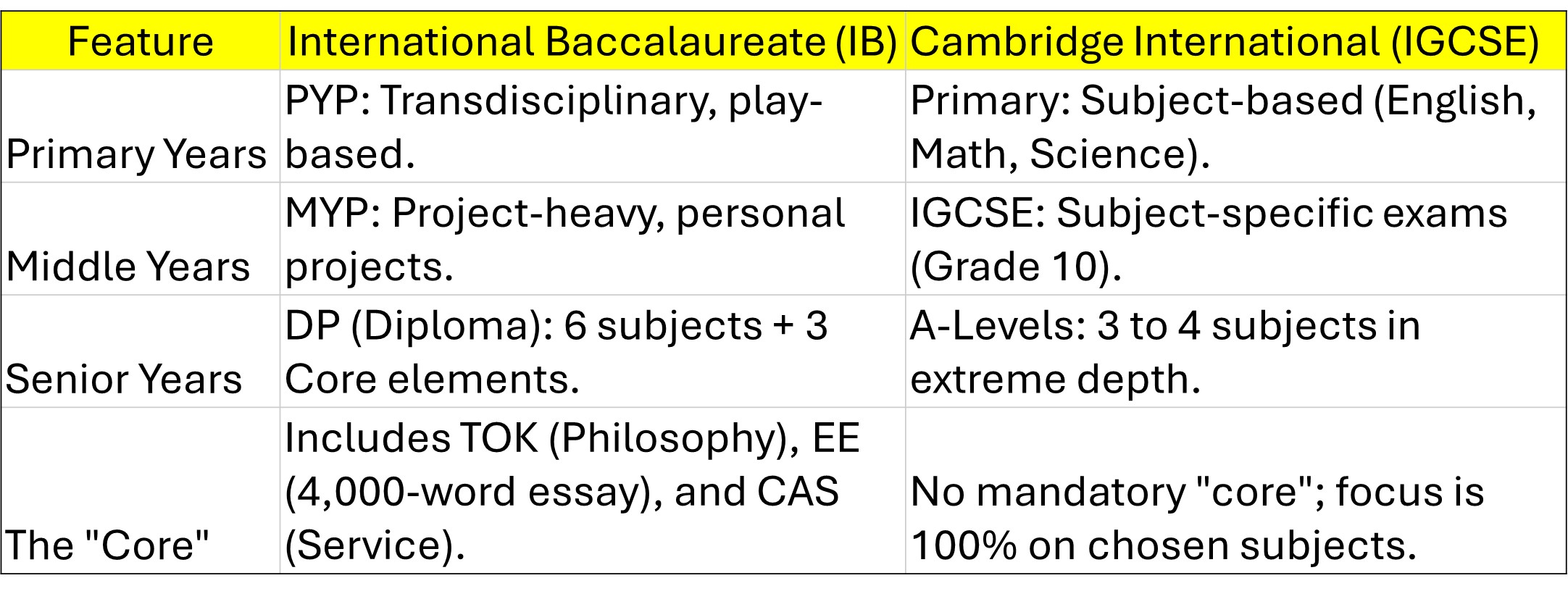
3. Assessment Style: Continuous vs. Final
- IB is a Marathon: A large chunk of the final grade comes from Internal Assessments (IAs)—essays, lab reports, and oral presentations done throughout the two years. A student cannot "cram" at the last minute and succeed in IB.
- Cambridge is a Sprint: While there is some coursework, the weightage is heavily on the final board exams. This suits students who perform well under exam pressure and prefer a clear, defined syllabus.
4. University Pathways (India vs. Abroad)
- Studying Abroad: Both are gold standards. However, US universities often love the "well-rounded" IB student, while UK/European universities often prefer the deep "subject mastery" of Cambridge A-Levels.
- Studying in India: * Cambridge is slightly more "India-friendly" because it aligns better with the traditional testing style of Indian entrance exams (JEE/NEET).
- IB students often find the transition to Indian colleges harder due to the vastly different evaluation styles, though the Association of Indian Universities (AIU) recognizes both.
5. The "Wallet" Factor (Fees in 2026)
In the Indian market, IB is almost always more expensive.
- IB Schools: Generally range from ₹6,00,000 to ₹15,00,000+ per year. The cost is higher due to mandatory teacher training in Geneva and expensive resources.
- Cambridge Schools: More flexible, ranging from ₹2,00,000 to ₹8,00,000 per year. There are many "budget" international schools in India that offer Cambridge but not IB.
The Verdict: Which should you choose?
- Choose IB if: Your child is a self-starter, loves writing, enjoys community service, and is definitely heading to a top-tier global university for a liberal arts or multi-disciplinary degree.
- Choose Cambridge if: Your child wants to specialize early (e.g., only wants to study Physics, Chem, and Math), prefers a structured syllabus, or wants to keep the door open for Indian competitive exams.
The Parent’s Decision Checklist: IB vs. Cambridge
Use this checklist to determine which international board aligns with your child’s personality and your family's long-term goals.
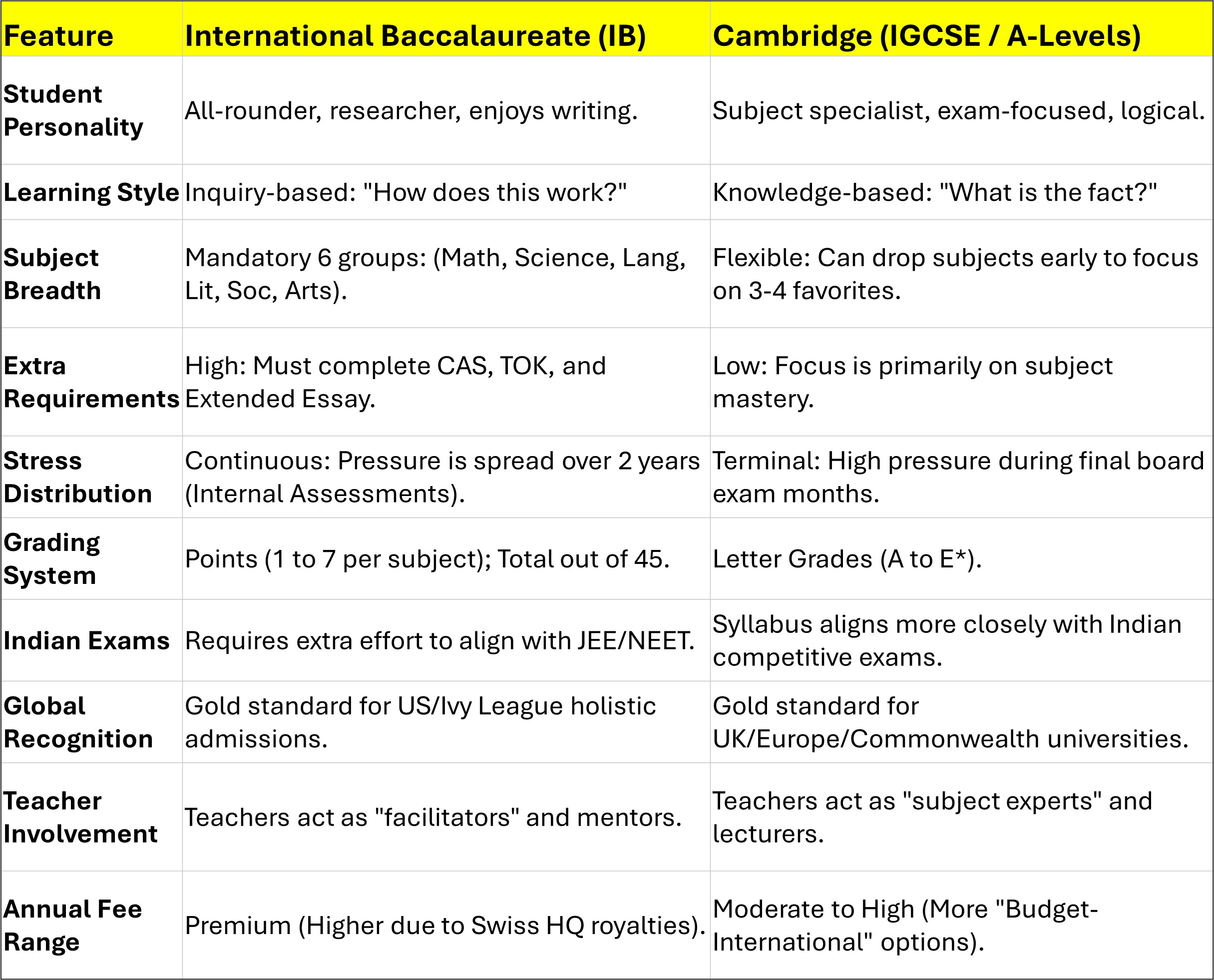
IB vs. Cambridge
How to use this Checklist:
- If you checked more boxes in the IB column: Your child likely thrives in a creative, self-directed environment and is aiming for a multi-disciplinary future (Liberal Arts, Design, Management, etc.).
- If you checked more boxes in the Cambridge column: Your child likely prefers a structured path with deep focus and is aiming for specialized fields (Medicine, Engineering, Pure Sciences, or Law).