CBSE vs ICSE vs Cambridge vs IB: The NRI DeshWaapsi Guide to Returning to India
The process of transitioning a child from a US-style of education to the Indian model is as much a process of "unlearning" as it is of "learning." You're absolutely right in that, while children in elementary school are like sponges, it is in middle school that the "Indian Education Cliff" is encountered—in particular, with respect to the sudden spurt in academic intensity and the infamous 3-language formula.
The transition for your children from life in the US to life in India is huge. For your kids, the school board is not merely a set of syllabi; it is the "operating system" for their future. Mainly choosing the right board for your child depends on the below 3 factors:
1. The "Transition Angle"
2. Career Goal Alignment
3. Operational & Lifestyle Factors
1. The "Transition Angle"
Let's dive deep into how The Transition Angle affects our decision in choosing the correct board for NRIs in India:
a) The Simple Rule of Age
Elementary (Grades 1–5): Kids are resilient. They adapt to any board (CBSE, ICSE, etc.) easily. They learn languages fast and don't mind the change in style.
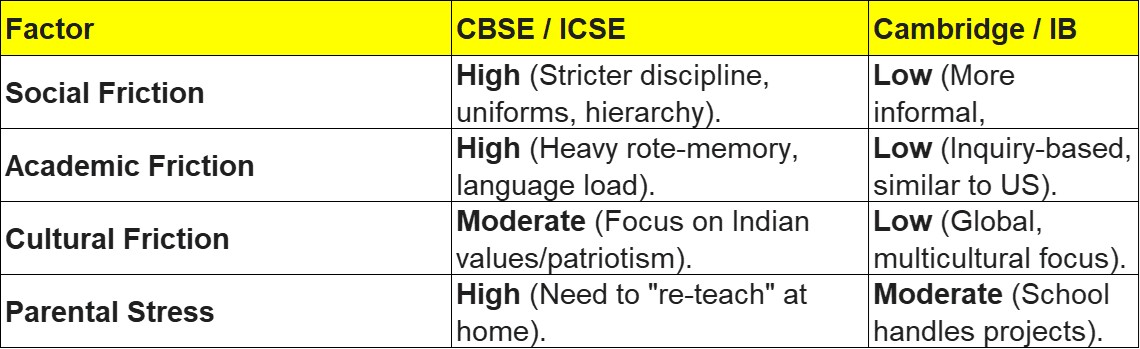
Middle School (Grades 6+): Transition becomes difficult. The "Language Wall" (Hindi/Marathi) and "Rote Learning" (memorization) kick in. This is where the US-to-India gap feels the widest.
Here is an analysis of why that transition "cliff" exists and how the International Boards (IB/Cambridge) act as a bridge.
b) The "Language Wall" (The Biggest Hurdle)
In the US, a second language is often elective or introductory. In India:
The 3-Language Formula: Most CBSE/ICSE schools require three languages until Grade 8 (English, Hindi, and a Regional language like Marathi).
The Depth: By Middle School, Indian boards expect students to write long-form essays and understand complex grammar in the second language.
The Advantage of International Boards: IB and Cambridge are much more flexible. They often treat the second language as "Language B" (acquisition-based), which is far less intimidating for a child who hasn't grown up reading and writing Hindi or Marathi script.
c) Rote Learning vs. Conceptual Inquiry
The Indian Board Shift: From Grade 6, CBSE and ICSE move toward a high-volume, "definitive answer" model. Students are often tested on their ability to reproduce specific textbook definitions word-for-word.
The US/International Model: Middle schoolers from abroad are used to "Inquiry-based learning"—asking why and how.
The Conflict: A child used to explaining a concept in their own words might actually lose marks in a traditional Indian board for not using the "keywords" found in the textbook.
d) The "Volume" Shock
The sheer number of notebooks and textbooks in an Indian Middle School can be a physical and mental shock.
CBSE/ICSE: History, Civics, and Geography become three distinct, heavy units. Physics, Chemistry, and Biology also start splitting into specialized areas with massive amounts of factual data to memorize.
International Boards: They maintain a "Integrated Science" or "Integrated Humanities" approach longer, which feels more like the US middle school structure, allowing the child to breathe while they adjust to the new culture.
2. Career Goal Alignment
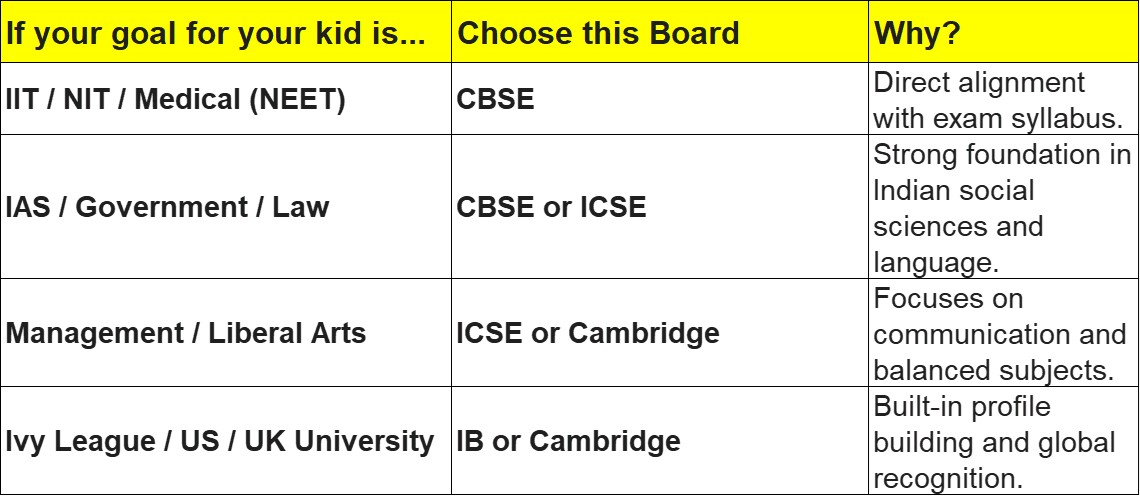
Returning to India after years abroad is a massive shift. For your children, the school board isn't just a curriculum—it's the "operating system" for their future. Below is a detailed breakdown of how these boards align with specific career aspirations and the transition from a US-style education.
a) CBSE (The "National Competitive" Board)
Best For: Cracking Indian entrance exams like IIT-JEE, NEET, and UPSC (IAS).
The Logic: Almost all national competitive exams in India are based on the NCERT syllabus, which is the core of CBSE. If your goal is for your son to become an engineer via the IITs or a doctor via NEET, CBSE is the most direct path.
For the Returnee: Coming from abroad, the transition can be "culturally" stiff. It is more textbook-centric and exam-heavy. However, it is the most widely available board in cities like Pune, making school hunting easier.
Career Alignment: High for Science, Engineering, and Government services.
b) ICSE / ISC (The "Language & Depth" Board)
Best For: Developing strong English, humanities, and a "well-rounded" academic profile.
The Logic: ICSE is famous for its rigorous English language requirements. It treats every subject with equal importance, meaning a student cannot "skip" or focus solely on Science until Grade 11.
For the Returnee: Your children will likely find the English curriculum familiar and perhaps even "easier" than their Indian peers, but they might be overwhelmed by the sheer volume of the syllabus in other subjects like History and Geography.
Career Alignment: Strong for Law, Management (MBA), Journalism, and Liberal Arts.
c) Cambridge (IGCSE/A-Levels) (The "Middle Path")
Best For: A mix of global standards and Indian academic depth.
The Logic: It follows the UK curriculum. It is more application-based than CBSE/ICSE but still maintains a structured exam format. It offers subject flexibility—a student can take Physics along with Art or Music.
For the Returnee: This is often the smooth transition point. The inquiry-based learning will feel like their US school, but the content is rigorous enough to satisfy Indian parents' academic expectations.
Career Alignment: Versatile. It is highly respected for admissions in the US/UK but is also fully recognized for Indian universities.
d) IB (International Baccalaureate) (The "Global Citizen" Board)
Best For: Critical thinking, research, and students definitely planning to go back abroad for University.
The Logic: IB doesn't use standard textbooks; it uses "Inquiry." Students are graded on research papers (Extended Essay) and community service (CAS).
For the Returnee: This is the closest match to high-end private schooling in the US. The "PYP" (Primary Years Programme) will feel exactly like a modern US elementary school.
Career Alignment: Excellent for Ivy League/International admissions. However, it is the hardest board to use as a base for Indian exams like JEE/NEET because the curriculum doesn't align with the "speed-math" and "rote-facts" required for those tests.
3. Operational & Lifestyle Factors
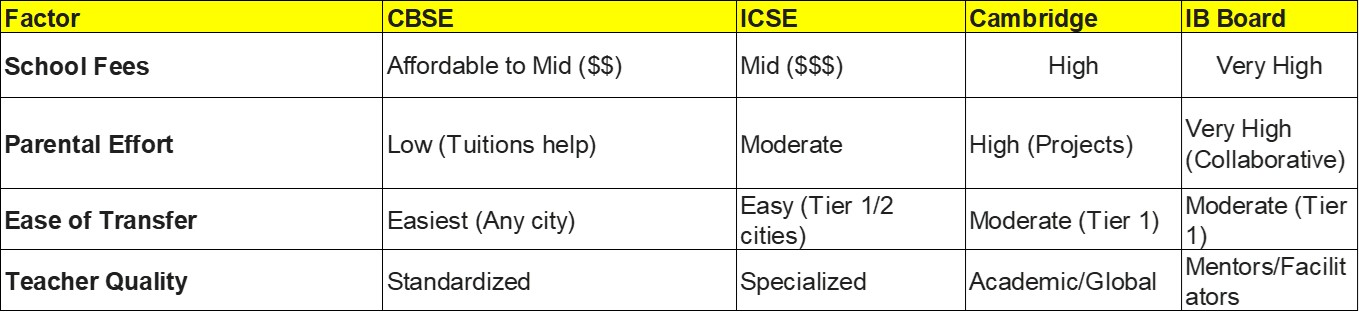
The board you choose will define your family’s daily life, budget, and where you choose to live.
a) Financial Commitment:
CBSE/ICSE: These are the most accessible. Annual fees typically range from ₹1,00,000 to ₹4,00,000. They are available in almost every neighborhood, offering more flexibility in where you choose to rent or buy a home.
Cambridge/IB: These represent a "premium" lifestyle. Annual fees can range from ₹4,00,000 to ₹15,00,000+. These schools are usually located in specific "hub" areas of Tier-1 cities, often necessitating a move to those specific zones to avoid long commutes.
b) Parental Involvement:
CBSE: Often described as "low-maintenance" for parents because there is a massive ecosystem of external tutors and coaching centers that can take over the academic heavy lifting.
IB/Cambridge: These boards demand "high-touch" parenting. You will be involved in research projects, community service initiatives, and school presentations. It requires more of your time but often leads to a social circle of other like-minded NRI/Expat families who share similar values and transition challenges.
The Best "Deshwaapsi" Strategy
For families returning to India, the "Transition Angel" strategy is simplified based on the child's age at the time of the move:
Elementary (Kids below age 8): Do not worry about the board choice too much. Children in this age bracket are incredibly resilient and adapt seamlessly to all systems, including traditional Indian boards like CBSE or ICSE. They pick up local languages quickly and adjust to the structure without much "academic shock."
Middle School (Grades 6–8): This is the most sensitive transition period. Choosing the Cambridge (IGCSE) board is highly recommended. It acts as a perfect bridge, offering the inquiry-based learning style they are used to in the US while gradually introducing the academic depth required in India.
High School (Grade 9 onwards): If a child returns this late, the IB Board is usually the best choice. It aligns with the global standards, project-based work, and critical thinking they have already mastered abroad, ensuring they don't get bogged down by the sudden switch to the heavy rote-learning often found in national boards.